Opheliaai موجه:Create a vertical split-style image. The entire canvas is strictly vertically ar…
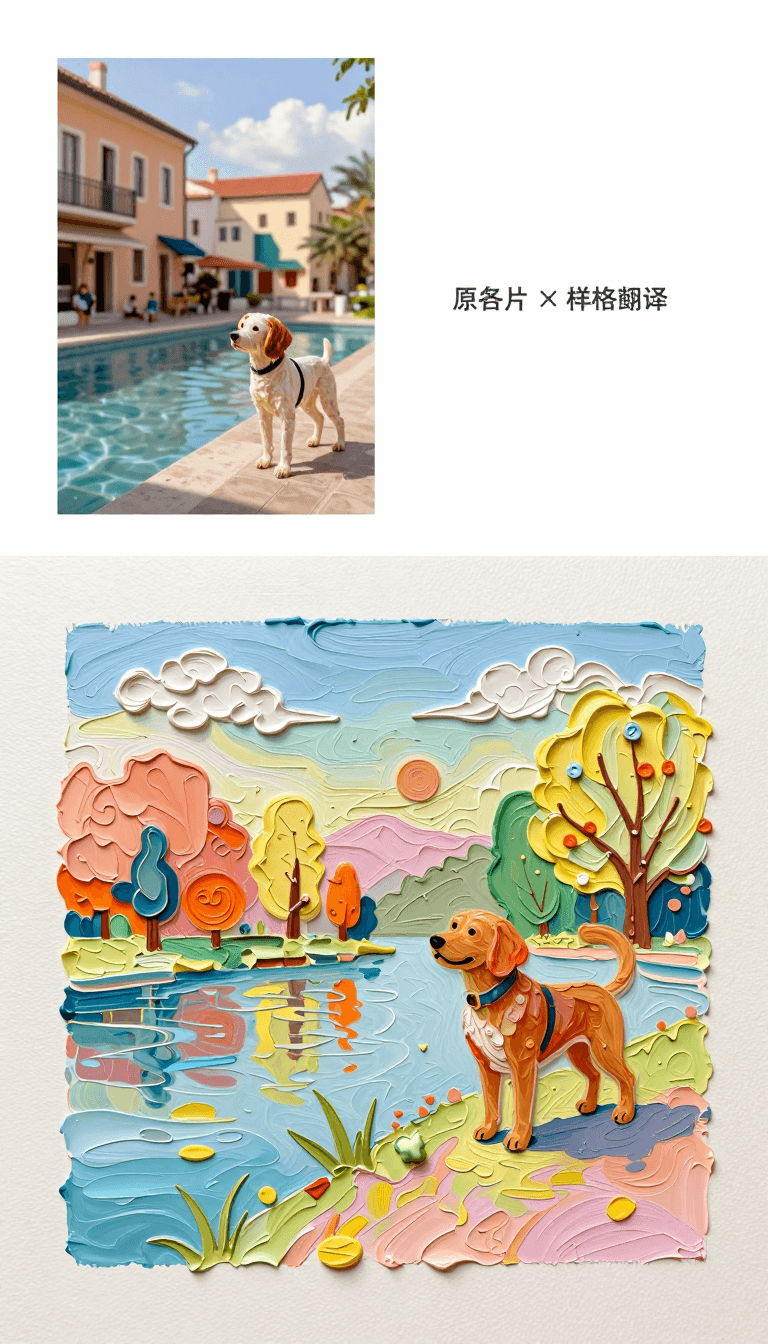
Create a vertical split-style image. The entire canvas is strictly vertically arranged, with the top half and bottom half heights accurately at 1:1, forming a clear split structure of "original photo × style translation." Top half: Directly display the original photo uploaded by the user and treat it as the unique source of subject reference. The top half focuses on preserving core subjects such as people, pets, or animals from the original photo, retaining their most recognizable facial features, fur or hair color, posture, actions, clothing, accessories, expressions, and overall temperament. Architecture, street scenes, interior structures, furniture, background decorations, etc., should not be the main subjects but exist only as auxiliary environments and can be appropriately weakened. Maintain an overall realistic photo texture, natural lighting, and original shooting atmosphere, clearly showing that this is the original reference photo before style translation. Bottom half: Extract the most recognizable subjects, outlines, postures, and narrative relationships from the top photo, and reconstruct them into a 3D impasto oil painting style micro-landscape illustration poster. Do not mechanically replicate the photo, but transform the subject into an exquisite, three-dimensional, touchable miniature landscape, reshaped with thick brushstrokes, color layering, and a sculpture-like sense of volume; preserve the core identity and key characteristics of the subject while moderately optimizing angles, proportions, and details to make it more suitable for a micro-landscape presentation. The priority for the subject is the person, pet, or animal itself, not based on architectural style, and do not make buildings, furniture, or environments the main visual center. The composition uses large areas of negative space + a centered or slightly off-center diagonal main axis. On a bright white textured paper surface, a touch of clear impasto color band related to the theme of the original photo supports the subject. This color band can be transformed into water, ground, paths, light bands, or abstract landscape slices; the subject interacts naturally with the color band, and reflections, ripples, light spots, or extended brushstrokes are added according to the content. The background retains only a small amount of impasto clouds, sun, mist, or natural imagery related to the subject's mood, forming a light and poetic spatial layer. The painting language emphasizes impasto oil painting × miniature entity × clear light sense. Preserve obvious pigment accumulation, palette knife marks, undulating edges, paper texture, and a semi-manual sculpting feel; impasto is concentrated on water surfaces, clouds, color bands, and local highlights, making the subject both exquisite and three-dimensional, while having the material feel of real oil paint. The color scheme extracts the brightest, most vivid, and most vital colors from the uploaded original photo for modulation, rather than average color sampling. Overall increase brightness and color purity, using clear sky blue, lake cyan, tender green, warm yellow, coral orange, peach pink, and other bright hues naturally derived from the original photo, forming a healing sense through refreshing warm and cold relationships. Use a large amount of pure warm white as breathing space, the main colors are distinct but not dazzling, and local warm orange, golden yellow, or pink can serve as sun-like highlight colors, giving the picture a sunny, vivid, warm, light, and vital color spirit. Avoid grayish, old, low-spirited Morandi-fication, dark brown filters, fluorescent colors, and cheap candy feel. Minimal text intervention. A short title can be refined from the identity, emotion, or symbolic meaning of the subject in the photo, paired with a very small amount of subtext, numbers, or miniature notes. The text remains detailed, restrained, with ample white space, and can be cleverly arranged along the diagonal main axis, the edge of the subject, or large areas of blank space, like exquisite annotations in an art publication. The overall presentation features a bright white background, vivid impasto, clear colors, miniature subjects, large areas of white space, and warm light, collectively forming a high-end healing temperament. Whether the subject in the top half is a person, pet, or animal, the bottom half should maintain a clear identity and vivid colors, avoiding grayish, dull, cartoon toy-like, plastic computer rendering feel, e-commerce feel, and template feel. Overall requirements: The bottom half must allow someone to recognize at a glance that it is a stylized reconstruction of the same subject in the top half. Do not make scene architecture the protagonist, do not generate irrelevant second subjects, do not let the style relationship between the top and bottom parts break, and do not include unnecessary watermarks, logos, or long explanatory texts.